



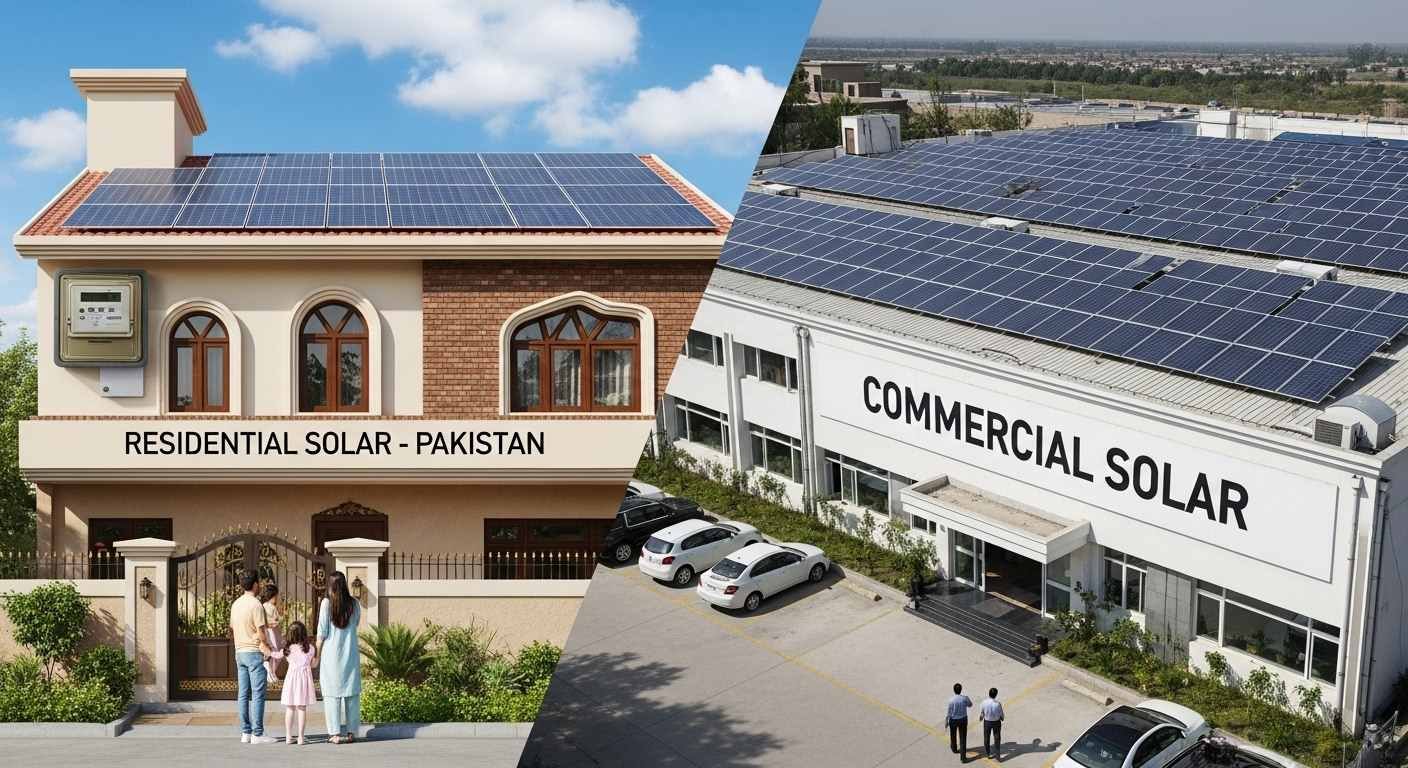
Difference Between Residential and Commercial Solar in Pakistan
As Pakistan is continuously facing energy shortage and rising electricity costs, solar energy has now become a practical and solar solution for both the household and businesses . Solar is no longer limited to homes; industries and businesses across major cities are now making the switch as well . With its long-term savings and environmental value, solar energy continues to gain attention, Knowing the difference between residential and commercial solar helps in choosing the right system.
Residential Solar System
Home solar systems provide power for daily household needs. Their scales ae usually smaller, starting the range from 1 kW to 10kW which depends on the size of the home and monthly electricity consumption. In Pakistan, a typical home uses about 300–600 units of electricity each month, which a 3–5 kW solar system can usually handle.
Features and Considerations
Residential solar installations are compact and designed to fit rooftops efficiently. They are limited primarily by roof space and household energy requirements. The upfront cost is generally lower than that of commercial systems, making them accessible for middle-class families. Many homeowners in Pakistan take advantage of government incentives, bank loans, and easy instalment plans from solar companies.
Benefits for Homeowners
• Reduce electricity bills a lot, and in some cases, get them close to zero..
• Gives you reliable electricity, even during summer power cuts.
• Cuts pollution and is better for the environment.
• Over time, it saves more money than it costs to install.
Commercial Solar Systems
Commercial solar systems are built in a way that can meet the demand of high electricity of different businesses, factories ,offices , and large institutions. Commercial setups in Pakistan usually range from 50kw to several megawatts , which totally depend on the size and energy need of the operation. Industrial hub like Sialkot, Gujranwala, and Karachi are witnessing a rapid increase in the commercial.
Features and Considerations
Commercial solar systems are built on a much larger scale, often spread across several rooftops, open land, or purpose-built solar areas. While the upfront cost is higher, stronger energy usage often leads to quicker returns. Most Businesses recover their investment within the time span of 3-5 years , which make the solar a strong and long-term financial decision.
Grid interaction is also a key feature. Businesses can use net metering, but many prefer a mix of solar and grid electricity for consistent power.
Maintenance is more complex than in residential systems. Commercial solar systems require regular inspection, monitoring of large panel arrays, inverter servicing, and periodic battery checks to maintain efficiency and reliability.
Why It’s Good for Businesses
• More reliable energy with less dependence on the grid and diesel generators.
• Helps the environment and makes the company more sustainable
• Saves money over time and keeps operations running smoothly.
For businesses ,investing in commercial solar systems is not just a cost-saving measure but also a strategic move to promote sustainability and corporate responsibility. It provides dependable energy while helping companies be eco-friendly and meet their customers’ needs.
Understanding the Key Differences
The key difference between residential and commercial solar systems lie in size, intended use, investment level, energy handling, and maintenance needs. Residential systems are very small designed for individual household needs , and focus on their cost effectiveness and simplicity. On the other hand, Commercial systems are large , which are capable of supporting substantial energy loads , and then prioritize efficiency , scalability , and operational continuity.
Residential solar system are perfect for homes that want reliable power and lower bills over time. Commercial systems on the other hand designed for industries and businesses that need high power capacity and uninterrupted operations.
Choosing the right system depends on the energy requirements, available space, budget , and the desired level of energy independence. By understanding these differences , Homeowners and businesses can choose solar solutions that deliver better savings and reduce reliance on the national grid.
Powering Pakistan’s Future with DSG Energy
DSG Energy has played a key role in helping more people and businesses across Pakistan switch to solar energy. They work on both home and business solar projects, designing each system to match energy needs and get the best performance. Whether it’s a small home in Lahore or a big textile mill in Faisalabad, DSG Energy offers solutions that help cut electricity costs and support a cleaner future.
Every solar system brings us closer to energy independence. Investing in the right system is so important because right system means ensuring long-term savings, Continuous electricity and a cleaner environment.
“Harnessing the sun today secures a brighter and cleaner tomorrow.”
FAQs
A home solar system that’s the right size can handle most of your electricity needs, though the outcome depends on your usage, the system’s capacity, and how much sunlight your area gets.
Homes and businesses can use net metering to feed any extra electricity they generate back into the grid, which helps reduce their electricity bills.
Good-quality solar panels in Pakistan can work efficiently for 25 to 30 years if they are well maintained.
