


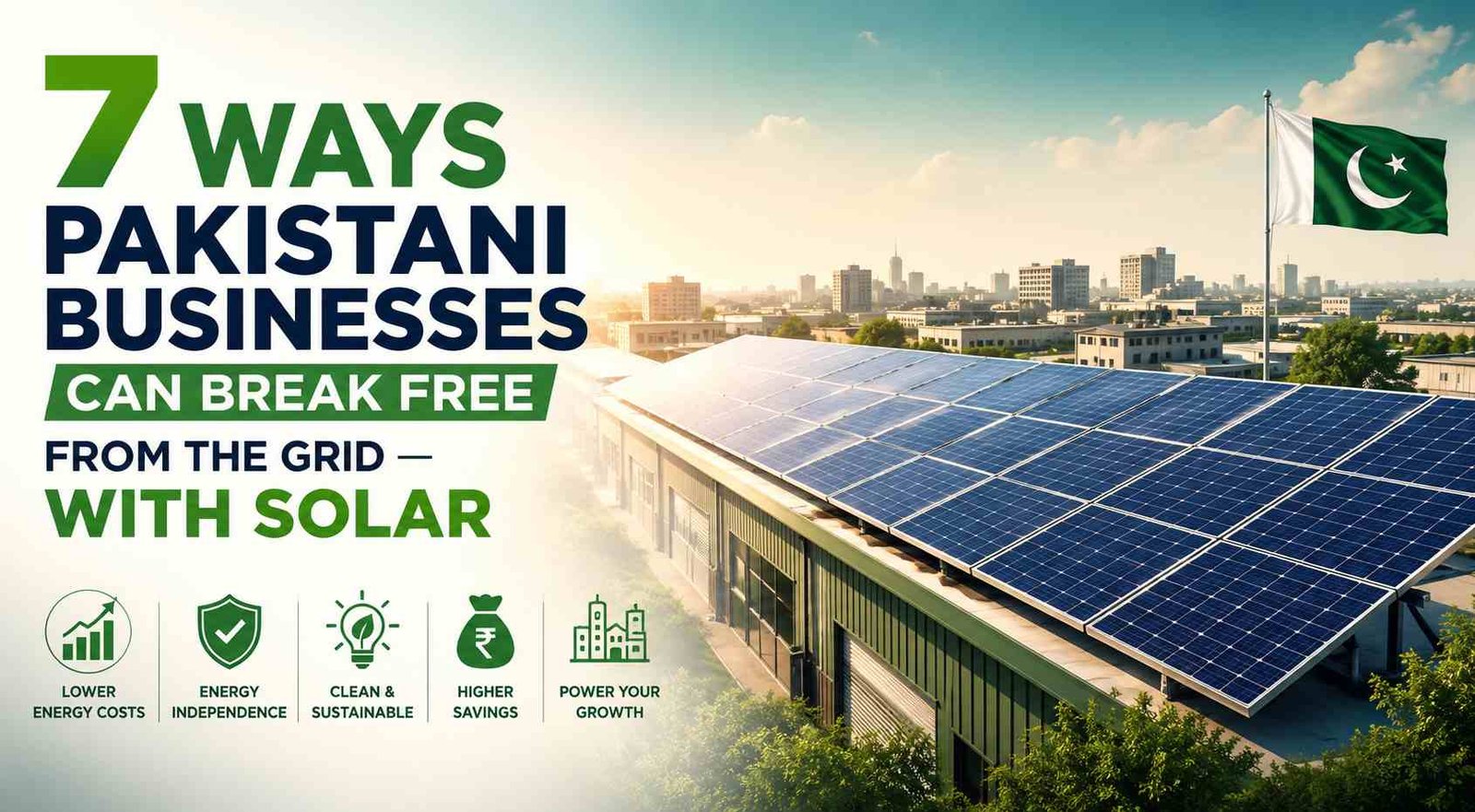
7 Ways Pakistani Businesses Can Break Free from the Grid With Solar
Electricity in Pakistan has stopped being a predictable line item. One month it’s a tariff hike, the next it’s an unannounced outage that costs you a whole production batch. Business owners are getting used to budgeting for chaos, not just consumption.
If you’re running a textile unit, a food processing plant, or even a mid sized retail space, you already feel this. The grid used to be something you could count on in the background. Now it’s something you have to actively work around.
More companies are turning to solar for exactly this reason. Not because it’s trendy, but because it actually solves a real problem. Going independent doesn’t mean disconnecting from the grid completely. It just means the grid stops being the only thing standing between you and your next production run.
1. Generate Your Own Power
Panels on the roof, or on open ground if that’s what you’ve got, and you’re making your own electricity during the day. That power runs your machines, your lighting, your office setup, all without waiting on someone else to send it your way.
Less bought from outside means less of your business depends on someone else’s schedule.
2. The Tariff Notices Stop Being Scary
Anyone who’s run a business here knows the drill. A new adjustment shows up, and suddenly you’re redoing margins and explaining price changes to a client who doesn’t want to hear it.
Once a solar system is running, the cost of that chunk of your electricity is more or less fixed for years, sometimes decades. You stop flinching every time the power company sends an update, because your numbers already account for it.
3. Operations Stay Steadier
A power cut is never just the minutes the lights are off. It’s the restart. The wasted batch. The delivery that’s now late. For a business running continuously, that adds up in ways that don’t show up on the electricity bill itself but definitely show up on the profit and loss statement.
Add battery backup or a hybrid setup and the grid becomes a backup plan instead of the main plan. That shift alone changes how much you can rely on your own schedule.
4. The Savings Compound
There’s an upfront cost. No point dressing that up. But most businesses start seeing the difference on their bill almost right away, and it keeps adding up well past the point the system has paid for itself.
That money doesn’t have to just sit there either. New machinery, expansion, hiring, whatever the business actually needs, it’s a lot easier to justify when energy isn’t quietly draining the budget every single month.
5. Buyers Overseas are Paying Attention
Textile exporters especially will recognize this one. International buyers now ask harder questions about how things get made. Sustainable manufacturing used to be a talking point. Now it’s something buyers actually verify before signing a contract.
Solar solutions give you something concrete to show them. Lower emissions, documented, not just claimed. For a lot of export businesses, that’s becoming less of a bonus and more of a requirement.
6. That Empty Rooftop is Worth Something
Drive past almost any factory or commercial building in Pakistan and you’ll see rooftops doing absolutely nothing. Sitting there in the sun, unused.
Solar makes that space work for you instead. No extra land needed, no major construction. Just infrastructure you already own, finally doing something useful.
7. It’s Less About Today and More About not getting Caught off guard
Demand for electricity in Pakistan isn’t shrinking, and the pressure to run cleaner operations isn’t going anywhere either. The businesses installing solar right now aren’t reacting to a trend. They’re just not waiting until they’re forced into it.
Energy independence isn’t only about this month’s bill. It’s about not being blindsided the next time prices, or regulations, shift again.
Why Businesses Keep Coming back to DSG Energy
Deciding to go solar is the easy part. Picking who actually builds and installs it is what determines whether the investment holds up.
At DSG Energy, we start by understanding what a client actually needs, not by pushing a standard package that’s easier for us to sell. Our team handles the design, the engineering, the installation, and stays around after commissioning to make sure the system keeps performing.
We’ve done this for textile mills, food processors, chemical plants, commercial buildings, and multinational operations across the country. The common thread is simple. Systems that keep working long after our crew has left the site.
This isn’t just about panels on a roof. It’s lower operating costs, more control over your own energy future, and a system that’s still doing its job in twenty five years, not just until the next tariff cycle hits.
A few Questions People Usually Ask
Relying less on the national grid by producing a real chunk of your own electricity, usually through solar. Steadier costs, fewer surprises, more control over one of the biggest line items on your budget.
No. Textile plants, food processing, pharma, warehouses, hospitals, schools, offices, most of these can use it. The system just needs to be sized right for what the business actually consumes.
Depends on consumption, system size, operating hours, the usual variables. But most commercial and industrial users see a real, lasting drop in electricity costs, and it tends to keep paying off for twenty plus years.
A properly installed one should keep performing well for twenty five years or more, assuming it gets basic maintenance along the way.
It can, if it’s built that way. Battery storage or a hybrid setup lets you keep running through an outage. Comes down entirely to how the system is designed upfront.
We handle everything ourselves, feasibility, engineering, procurement, installation, commissioning, and support after it’s live. Years of experience in Pakistan’s commercial and industrial sectors means we build systems that hold up, not just ones that look good on day one.
