


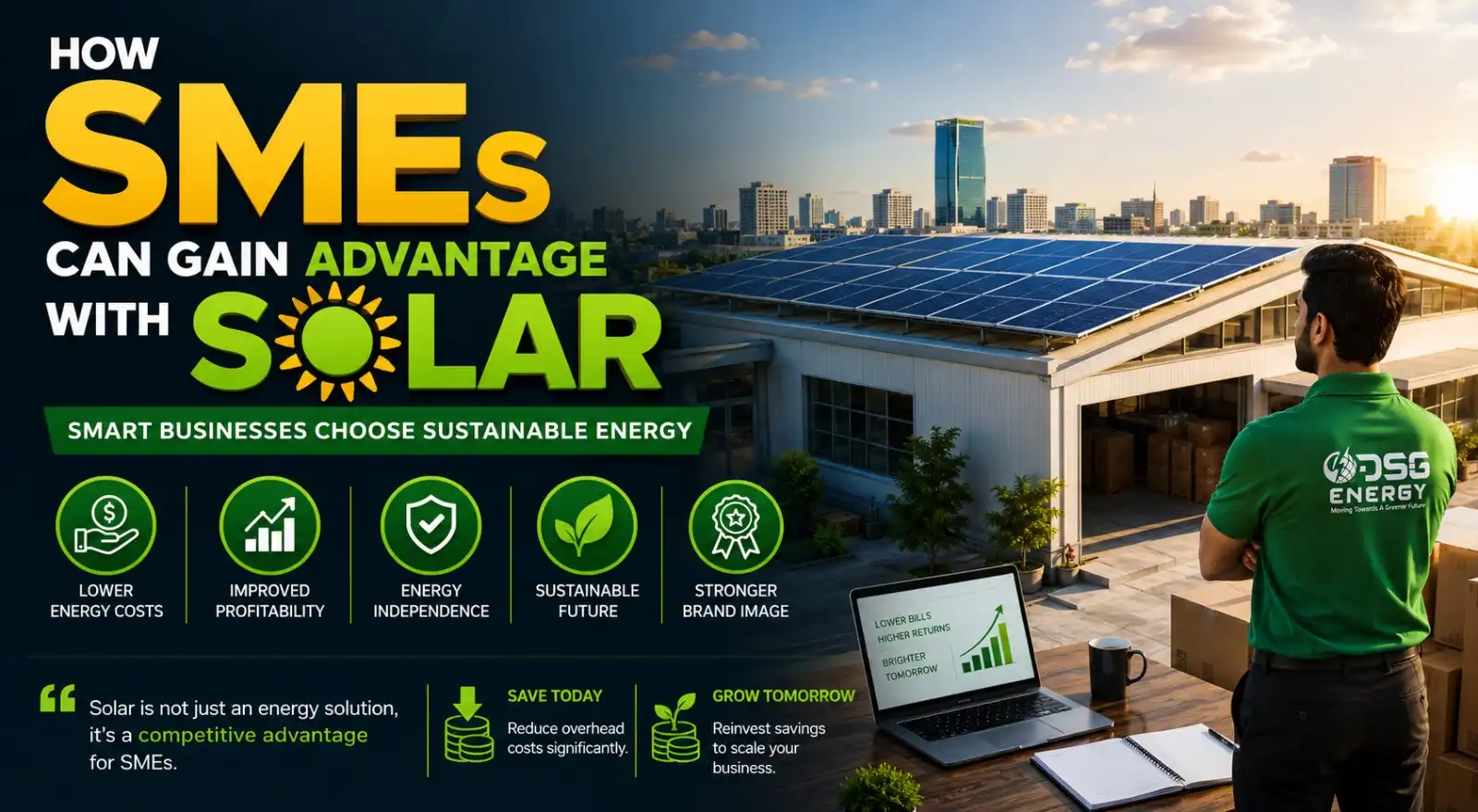
How SMEs Can Gain Advantage With Solar
A small and medium sized enterprises (SMEs) are the backbone of Pakistan’s economy, supporting employment, manufacturing, retail, services, agriculture, and countless other industries. Yet, for many SMEs, electricity is one of the biggest and most unpredictable operating expenses. Rising energy costs, changing tariffs, and dependence on grid electricity can put significant pressure on already tight profit margins.
Solar energy offers SMEs an opportunity to take greater control of their energy costs while building a more efficient and sustainable business. By generating electricity from sunlight, business can reduce their dependence on conventional power sources and redirect savings towards expansion, technology, employees, and other areas that support growth.
For an SME, solar is not simply about installing panels on a rooftop. It is a strategic investment that can improve financial stability, operational efficiency, and long-term competitiveness.
It Cuts the Electricity Bill
If your business runs mostly during daylight hours a workshop, a retail outlet, an office, a factory floor solar can start offsetting your grid draw almost immediately. You’re not waiting on some abstract future benefit; the savings show up on the very next bill, and they compound from there.
For a restaurant, a school, a warehouse, or a small manufacturer, that freed-up cash isn’t trivial. It’s money that was previously locked into a fixed cost and is now available for literally anything else the business needs.
It Insulates You from the Next Tariff Hike
Nobody can predict where electricity prices go next that’s the frustrating part of running a business on grid power. Solar sidesteps that guessing game. Once the system is up, sunlight is free, and your exposure to the next tariff announcement drops considerably.
That predictability matters more than people give it credit for. It means:
- Financial planning that isn’t built on guesswork
- Less anxiety every time a tariff revision is announced
- Operating costs that actually behave the way you budgeted them
- Freed-up capital that can go toward growth instead of absorbing price shocks
For SMEs competing on price and most are that kind of stability is a real advantage, not just a nice-to-have.
It Frees Up Cash Flow, Not Just Profit on Paper
Profitability and cash flow aren’t the same thing, and any SME owner will tell you cash flow is usually the one that actually keeps the lights on. Every rupee going to an inflated power bill is a rupee that isn’t available for inventory, payroll, or that piece of equipment you’ve been putting off buying.
Solar chips away at that recurring drain. The savings aren’t a one-time thing they show up month after month, and over a few years they add up to a meaningfully stronger balance sheet.
That Empty Rooftop Is Wasted Space
Most SMEs are sitting on an underused asset without realizing it: the roof. Warehouses, workshops, commercial buildings these often have flat, sun-exposed space doing absolutely nothing.
A proper solar assessment looks at what that space could actually generate, factoring in:
- How much rooftop area is usable
- Your actual consumption pattern (not just your bill total)
- Sun exposure across the day and year
- Whether the structure can support the load
- What your existing electrical setup can handle
That’s how a system gets sized correctly not by guessing, but by matching the install to how the business actually uses power.
Efficiency Gains Beyond the Bill Itself
Electricity is often invisible until it’s a problem until the AC struggles, the machinery trips, or refrigeration costs spike in summer. When you’re generating your own power during the hours you need it most, that alignment between generation and demand starts working in your favor.
Lighting, cooling, refrigeration, pumps, production equipment a well-designed system supports all of it. And for businesses with heavy daytime consumption, the match between when solar generates and when the business actually needs power is close to ideal.
Lower Costs Mean More Room to Compete
Here’s the part that’s easy to overlook: energy savings aren’t just savings, they’re leverage. A business spending less on electricity has more room to move on pricing, on hiring, on new equipment, on chasing a market it couldn’t previously afford to chase.
Solar, in that sense, stops being an “energy decision” and starts being a piece of the business strategy right alongside pricing, marketing, and expansion planning.
Sustainability Isn’t Just Optics Anymore
Customers notice. So do investors, partners, and increasingly, employees. Businesses that can point to real steps toward sustainability not just a line in a brochure tend to build more trust with the people they work with.
Solar doesn’t burn fossil fuel to generate electricity, which means every unit you produce on-site is a unit that isn’t adding to your carbon footprint. For SMEs starting to think seriously about ESG, it’s one of the more tangible steps available.
Today’s Systems Are Smarter Than You’d Expect
Solar in 2026 isn’t just panels bolted to a roof. Modern inverters and monitoring platforms let you actually see what your system is doing in real time, from a phone or laptop, without needing to climb up and inspect anything.
That visibility matters. If a panel underperforms or something needs attention, you find out fast instead of months later when the savings quietly stop showing up. A good provider will also tailor the technology to your business rather than handing you a generic package.
Think of It as a Long-Term Investment, not a Purchase
Solar isn’t a one-off expense it’s an asset that keeps producing for years after the upfront cost is paid. What you get out of it depends on a handful of factors: system size, your consumption profile, tariff trends, equipment quality, and how well the installation was actually done.
That last point matters more than people assume. A poorly engineered system underdelivers quietly you might not even notice until you compare notes with another business running a properly designed one. Quality equipment and careful engineering aren’t optional extras; they’re what determines whether the investment actually pays off.
The Provider You Choose Matters as Much as the Panels
This is where a lot of SMEs get it wrong, they shop for the cheapest quote instead of the best-engineered system. But the return on solar depends heavily on who’s designing and installing it.
Before signing with anyone, it’s worth digging into their track record: how many commercial projects they’ve actually completed, what equipment they use, whether they offer real monitoring, and what happens after installation when something needs servicing. A provider that treats installation as the finish line rather than the starting point tends to leave businesses with underperforming systems and no one to call when it matters.
DSG Energy: Built for Businesses That Want It Done Properly
DSG Energy has built a track record working with commercial and industrial clients across Pakistan, designing systems around how a business actually operates rather than a standard template. That means real engineering, dependable equipment, monitoring that gives owners visibility, and after-sales support that doesn’t disappear once the panels are up.
For SMEs looking to bring down electricity costs, run more efficiently, and build toward a more sustainable operation, working with a provider like DSG Energy makes the transition considerably less of a gamble.
“The best time to invest in smarter energy is before rising energy costs limit your business growth.”
Frequently Asked Questions
It reduces electricity costs, gives businesses more control over a volatile expense, strengthens cash flow, and supports long-term, sustainable growth.
Yes, system size is matched to available space and actual consumption. A proper site assessment will tell you what’s realistic before any commitment is made.
By generating part of your own power, you reduce how much you’re buying from the grid which means future tariff hikes hit you less hard, and your operating costs become far more predictable.
Track record, engineering ability, equipment quality, completed commercial projects, real monitoring tools, warranty terms, and critically what support looks like after the system is installed.
