


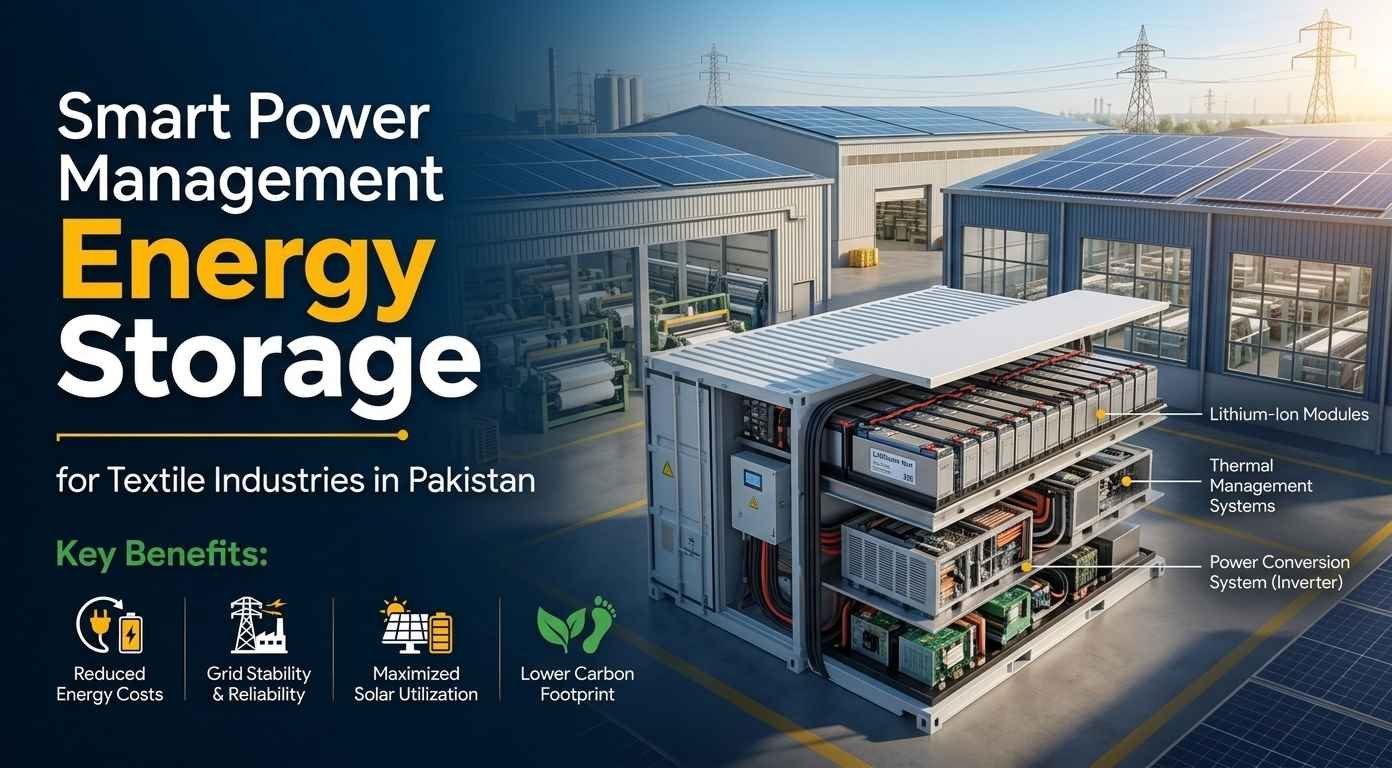
Energy Storage for Textile Industries in Pakistan: A Smarter Way to Manage Power
If you’ve ever walked a textile floor during a power cut, you know exactly what I’m talking about. The looms just stop. Someone’s yelling about a dye batch that’s about to go wrong. The shift supervisor is already on the phone. It’s not a big dramatic moment. It’s just annoying and expensive, over and over, week after week.
That’s the reality for a lot of mills in Pakistan right now. Spinning, weaving, dyeing, garment stitching, none of it forgives a gap in power. And electricity isn’t getting any cheaper either, which is why so many factories have already put solar on the roof. Good move, honestly. But solar alone doesn’t solve the whole thing. It generates power when the sun says so, not when the night shift needs it. That gap is where storage comes in.
A Battery Energy Storage System, BESS for short, banks power when it’s around and lets it go when it’s actually needed. Pair it with solar you’ve already got and suddenly the whole setup starts acting like one system instead of two things duct-taped together.
It’s Not Just How Much, It’s When
Ask most plant managers about their power bill and they’ll quote you a number: units consumed, rupees per unit, done. But honestly the more interesting question is when those units get pulled off the grid.
Textile plants load up hard during certain hours. Compressors, looms, HVAC, dye lines, motors, all running together, all at once, and depending on your tariff that can get pricey fast. Then on the flip side you’ve got outages, which let’s be real are still just a fact of life in a lot of areas rather than some rare event.
Storage won’t make either of those problems disappear completely. What it does give you is a bit of slack. Some room so the whole operation isn’t hostage to the grid or a diesel genset every single time demand spikes.
What’s Actually in the Box
Not much mystery here, if I’m honest. Batteries, some power electronics to manage what’s flowing in and out, control software, safety systems so nothing catches fire. That’s basically it.
For a plant that’s already got solar, the logic kind of writes itself. Midday, on a good clear day, the panels are usually pumping out more than the factory’s using right then. Normally that extra either gets sold back to the grid for next to nothing or just wasted. With a battery sitting there, it gets banked instead. Ready for the evening shift. Ready for a cloudy stretch. Ready whenever.
Generation, storage, consumption. Instead of three separate things, it starts behaving like one connected loop.
Solar Plus Storage, Specifically for Here
Solar makes a ton of sense in Pakistan. Roof space isn’t usually the constraint, and sunlight definitely isn’t in short supply. But the sun doesn’t punch a shift card. Night production keeps going whether the panels are producing or not, and monsoon season doesn’t care about your monthly targets.
Storage is really just about closing that gap between when the sun shows up and when the factory actually needs the electricity. Whatever gets captured at noon can still be doing useful work at midnight.
What You Actually Get Out of This
More control, probably the biggest one. Instead of using power the instant it’s made, or pulling blind from the grid, you get to choose when the stored energy actually gets used. Across multiple shifts with lopsided demand, that matters more than people expect.
Less reliance on one single source. The grid’s not going anywhere and it shouldn’t, but betting everything on it leaves a plant exposed to outages that are entirely out of its control. A properly sized battery bank is just a second leg to stand on.
Solar that stops going to waste. Without storage, a real chunk of what your panels produce just isn’t captured. The factory’s not using it in that exact minute, so the value’s gone. Storage closes that gap, and honestly it’s usually the difference between a solar system that pays for itself quickly and one that takes forever.
A cushion when the power actually does go out. A lot of textile equipment can’t be shut off mid-cycle without creating a headache. A system sized right can keep the critical stuff running through an interruption instead of an emergency shutdown scramble.
And you get to see what’s happening, finally. Most setups now come with monitoring software: charge patterns, discharge patterns, where losses are creeping in. Facility teams routinely find inefficiencies they had no idea were sitting there.
Does Every Factory Need One?
No, not really. A spinning unit pulls power completely differently than a dyeing facility does. A plant running one shift needs a totally different setup than one running around the clock.
Sizing a system off battery capacity alone, how many kWh sounds good, is basically how people end up either overpaying or underbuilding. The smarter way in is to start with the actual numbers: load profile, peak demand, current solar output, operating hours, which loads are genuinely critical, what shape your existing electrical setup is in. Get that right first and the rest, capacity, power rating, control strategy, tends to fall into place.
Where All This Is Going
The conversation around industrial power has shifted, even just in the last few years. It used to be almost entirely “how much did we use and what did it cost.” Now it’s shifting toward the full loop: generate it, store it, use it with a bit more thought than just flipping a switch.
For Pakistan’s textile sector specifically, competing in a genuinely brutal global market, that’s not a minor detail. Costs and reliability are competitive advantages, and energy strategy is quietly becoming part of that fight whether people admit it or not.
Why DSG Energy
Storage isn’t just bolting a rack of batteries to a wall and walking away. The real value only shows up when the system’s actually built around how a specific factory uses power, not some generic spec sheet pulled off a shelf.
DSG Energy puts solar, storage, and monitoring together as one system for commercial and industrial clients, rather than treating them as three separate purchases. For a textile manufacturer trying to figure out if BESS is worth it, that conversation usually starts with a proper look at the plant’s actual energy profile before anyone specs out equipment.
The idea at the bottom of all this is pretty simple. Waste less, depend less on any single source, build something a bit sturdier for whatever the grid throws at you.
A Few Questions People Actually Ask
Battery Energy Storage System. Stores electricity, releases it on demand, usually working alongside solar or the grid to cut peak reliance and back up critical loads when the power drops.
Usually, yeah. Depends on your inverter setup and how the existing wiring’s laid out, but retrofits are pretty common at this point.
It can. How much depends on your load profile, your tariff, solar capacity, battery size, how the plant runs day to day. Nobody can hand you a flat percentage without actually looking at your numbers first. Anyone who does is guessing.
For the critical stuff, yes, if it’s set up that way. How long it lasts is just battery size versus how much those loads are pulling.
That’s what the energy assessment is for: consumption patterns, peak demand, operating hours, solar capacity, which loads actually matter, how much backup time you actually want. Skip it and you’ll either overpay for capacity you don’t need or end up with something too small to be useful.
