


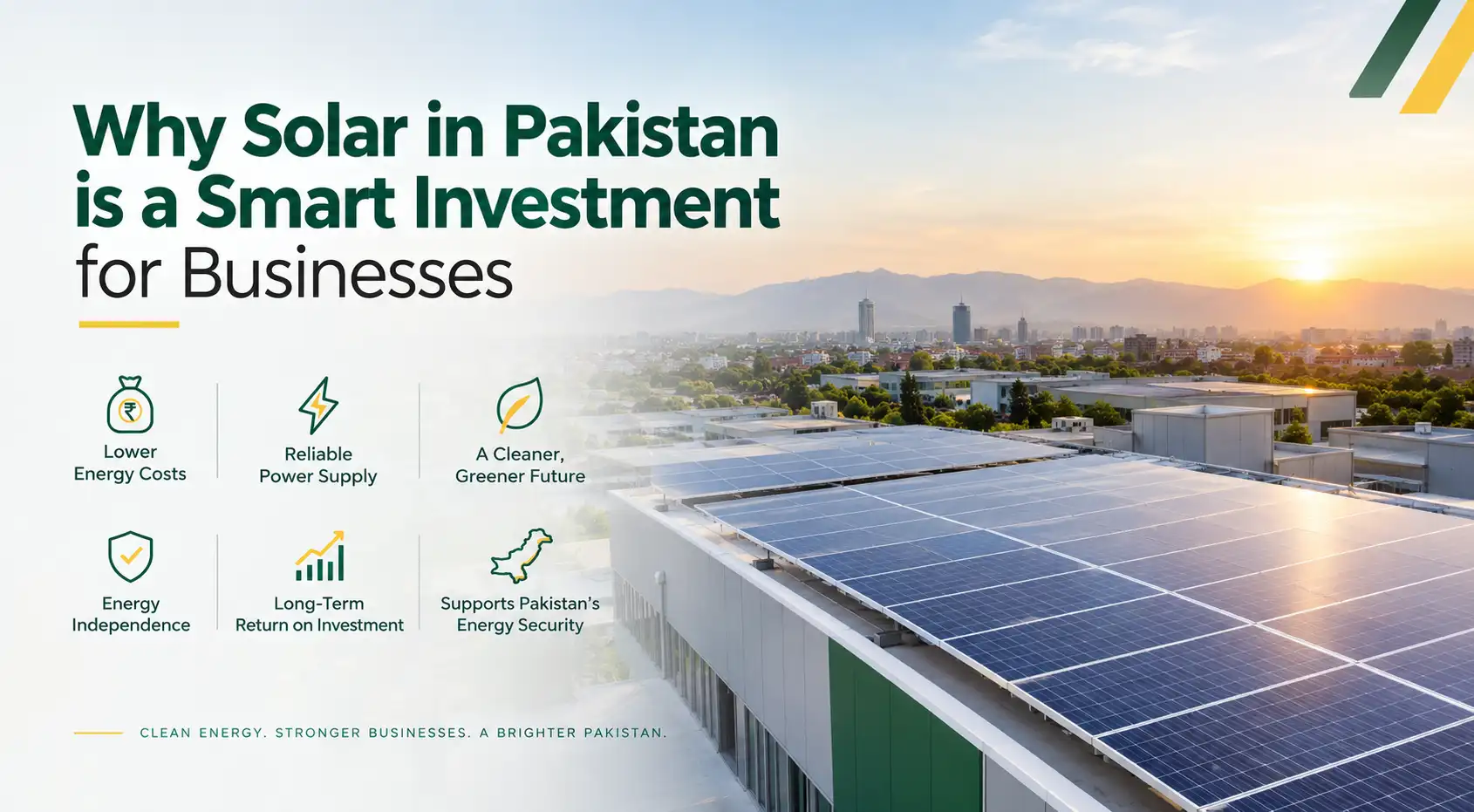
Why Solar in Pakistan Is a Smart Investment for Businesses
Electricity used to be a line item you budgeted for and forgot about. Not anymore. It now dictates production schedules, staffing decisions, operating hours, how far ahead a company can even plan. And when costs spike or the grid gets shaky, it’s the business that eats the difference.
That’s why solar has quietly shifted from a sustainability talking point to a cost strategy. Businesses across Pakistan aren’t installing panels because it looks good in a report. They’re doing it to control spending and stop being so exposed to a grid that keeps surprising them.
The numbers back this up. The IEA puts Pakistan’s 2025 solar PV additions at roughly 10 GW, most of it on grid and off grid distributed systems, and it specifically flags rising commercial and large scale off grid adoption here.
So what’s actually driving this?
Electricity Bills Don’t Stop Coming
Unlike most capital costs, electricity keeps showing up. Every month, every year, for as long as the doors are open.
Factories, warehouses, offices, retail floors, farms. Anywhere power gets used heavily during the day can end up sinking a huge chunk of its operating budget into electricity alone. And with tariffs shifting the way they have, guessing next year’s bill has become exactly that: a guess.
Solar won’t erase that uncertainty, but it changes the math. A properly sized system lets a business generate part of its own power instead of buying all of it. How much that saves depends entirely on the specifics: system size, consumption, local sunlight, equipment, financing, the tariff you’re on. There’s no universal number here. Every project needs its own calculation.
But the underlying logic is simple: make more of what you use, buy less of the rest.
It Turns a Recurring Cost Into an Asset
There’s a real difference between paying a bill and owning a system. A bill vanishes the second you pay it. A solar installation doesn’t.
Panels keep producing power for years, often decades, once they’re up. That means a commercial project can be planned around where the business expects to be in ten years, not just this year’s tariff.
So it’s not only a monthly expense getting cut. It’s an asset that keeps paying off for as long as it’s running, which matters most for companies with large rooftops, industrial sites, or open land where a proper system can actually go in.
Payback periods still swing widely from project to project. Cost, tariffs, expected output, financing, and maintenance all move that number. Anyone serious about this should be running it off their own consumption data, not a figure pulled from a sales pitch.
The Sun Cooperates Here
Most of Pakistan gets strong solar irradiation, so this isn’t limited to a handful of ideal locations. It works in far more places than that.
Businesses also have decent timing by default. A lot of commercial electricity use happens during the day, which is exactly when panels are producing.
Machinery running in daylight, AC running through the workday, shop lighting and coolers, irrigation pumps: all of it lines up with solar generation fairly naturally. That overlap is a big part of why commercial solar performs as well as it does here.
Some Insulation From Price Swings
No business controls where electricity prices go next. What it can control is how exposed it is when they move.
Solar reduces how much a business depends on the grid for whatever share of consumption the system covers. It’s not full independence. Output still shifts with weather, season, and how the facility runs, so most businesses keep grid power or another backup around regardless.
Still, cutting grid dependence by a meaningful margin changes how a business can plan years out.
Businesses wanting to go further can pair solar with Battery Energy Storage Systems (BESS). Batteries hold onto surplus generation and release it later, depending on how the system’s designed and what the business actually needs from it.
Staying Operational When the Power Isn’t
An outage costs more than what shows up on the electricity bill.
Production stops on the factory floor. Cold storage loses temperature control. Offices and shops simply can’t function. The damage spreads in ways that are hard to fully put a number on.
Solar paired with the right backup and storage setup can make a business’s power supply significantly more resilient, but “right” depends entirely on the business. Some sites just need daytime generation covered. Others need solar, batteries, backup power, and a smarter energy management layer on top of all of it.
Which is really the point: commercial solar isn’t panels bolted to a roof. It’s an energy setup built around what the business actually does day to day.
The Emissions Angle Comes Second, But It’s Real
Cost is usually what gets a business looking at solar in the first place. The environmental case tends to show up after.
Solar generates power without burning fuel on site, so adopting it cuts reliance on conventional power and lowers operational emissions along the way.
That’s started mattering beyond the balance sheet too, feeding into sustainability targets and giving companies something credible to point to when they talk about how they handle energy. For export focused businesses dealing with international clients, this has stopped being a side conversation. It’s part of the deal now.
Not Just a Residential Story Anymore
Solar’s growth in Pakistan hasn’t stayed confined to rooftop panels on homes.
NEPRA’s own approval records show distributed generation going into commercial and industrial users too: flour mills, cold storage operators, various other enterprises. The IEA lists Pakistan among the markets where commercial and large scale off grid solar is picking up, and globally, solar PV remains the single largest source of new renewable capacity, with over 600 GW added worldwide in 2025.
As the technology, equipment, and storage options keep getting more accessible, solar is turning into a standard part of business energy planning rather than a niche add on.
The Right System Beats the Biggest One
Different businesses need different things.
A small retail outlet might be fine with a fairly basic rooftop setup. A manufacturing plant is an entirely different scale of problem, usually a much bigger installation, real load analysis, attention to power quality, ongoing monitoring. A business dealing with frequent outages might get the most value from pairing solar with BESS specifically.
Before committing to anything, it’s worth looking at current consumption, monthly bills, the split between daytime and nighttime load, available rooftop or land space, existing electrical infrastructure, backup needs, expected generation, equipment quality and warranties, maintenance requirements, and financing.
The goal isn’t maxing out whatever capacity the roof can physically hold. It’s installing what actually fits the business.
Why DSG Energy
At DSG Energy, solar isn’t treated as a one off installation job. It’s built as an energy solution around whatever business it’s serving.
That covers the full stretch: system design, engineering, installation, monitoring, and the ongoing operations and maintenance after that, all aimed at matching what a business actually needs rather than what looks good in a proposal.
For commercial and industrial clients, that might mean solar alone, or solar combined with BESS, monitoring software, and other technologies, depending on the site.
As more businesses look to hold down costs, build in resilience, and move toward cleaner energy, a well designed solar project stops being a side experiment and becomes part of how they plan for the next decade.
The smartest investment isn’t necessarily the biggest system. It’s the one that fits the business, holds up over time, and actually delivers.
Frequently Asked Questions
Often, yes, especially for businesses with high electricity use and strong daytime demand. What it actually returns depends on project cost, usage patterns, tariff structure, expected generation, and financing.
Panels are generally built to run for decades, though output drops off gradually over time. Inverters and batteries have shorter lifespans and get replaced on their own schedule.
Not automatically. A standard grid connected system shuts down during an outage for safety reasons. Keeping power running for critical loads requires a backup system built for that, usually batteries plus extra power management equipment.
Yes, and it’s a fairly common pairing. Batteries store surplus solar output and release it when needed, which helps businesses that want more flexibility, backup capability, or tighter control over electricity use.
Start with the electricity bills and the load profile: how much power gets used, and when. Factor in available space and what the business is actually trying to achieve, and a proper energy assessment should tell you what capacity makes sense, and whether something like BESS is worth adding.
