


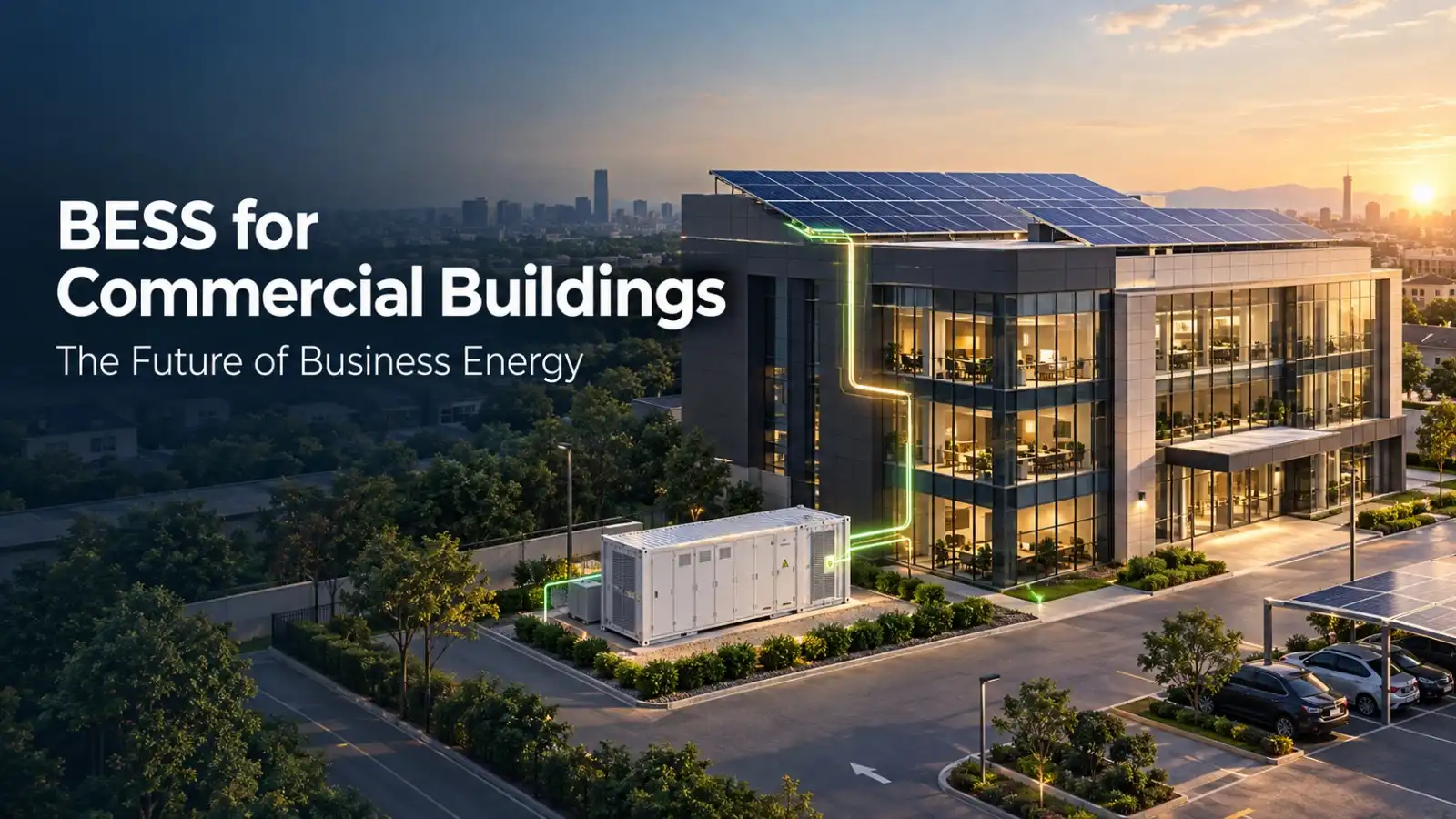
BESS for Commercial Buildings: The Future of Business Energy
Picture a shopping center on a hot afternoon. Air con running flat out, escalators moving, tills processing, cameras recording. Then the grid hiccups. Everything that made the building work a second ago is suddenly a problem.
That’s the scenario battery energy storage systems (BESS) exist for.
The idea itself isn’t complicated. Store electricity when it’s cheap or available, then use it later on your own terms instead of leaning on the grid every hour of the day. What’s changed is the price and reliability of the technology, and that’s why you’re seeing more of these systems actually going into buildings rather than just showing up in trade magazines.
What’s Actually Inside One of These Systems
A battery stores electricity — everyone gets that part. What gets missed is everything built around it: the power conversion gear, the software deciding when to charge and discharge, and the monitoring that lets someone actually see what’s going on.
Pair it with solar and it gets more interesting. Panels put out the most power around midday. Most businesses are still drawing hard on electricity at 6pm. Without storage, that midday surplus mostly gets wasted or sold back to the grid for next to nothing. With a battery, you bank it and use it when you actually need it.
The Peak Demand Problem
This is probably the biggest reason businesses bother with BESS at all.
Electricity use isn’t flat through the day , it spikes at fairly predictable times, and depending on your tariff, those spikes can really hurt on the bill. A battery discharges straight into that spike instead of pulling more from the grid, and that takes a lot of the sting out.
The industry calls this peak shaving. If your business has a reasonably predictable usage pattern — and most do — it turns a battery into a genuine cost-management tool, not just something sitting there for emergencies.
When the Grid Actually Goes Down
Outages cost more than the obvious downtime suggests. Restarting production equipment can eat up more time than the outage itself did. A transaction that drops mid-process because the till lost power leaves a mess that outlasts the blackout by hours.
A properly configured BESS kicks in the moment the grid fails. Servers, security, refrigeration whatever’s been flagged as critical just keeps running, no one has to touch anything.
Worth being honest about: a BESS won’t necessarily carry an entire building through a long outage unless it’s been sized for that specifically. What loads actually matter, how long backup needs to last, what the real usage pattern looks like get any of that wrong and the system either underdelivers when it counts or costs way more than it needed to.
Not Just for Big Factories
There’s a common assumption that BESS only makes sense at industrial scale. It doesn’t hold up.
Sizing comes down to consumption, load profile, backup requirements, existing solar, available space, and what the business actually wants out of it. A large industrial site might need something multi-megawatt. A smaller commercial building might do just fine with a fraction of that.
There’s no one-size-fits-all here. A proper look at actual energy use has to come first — the battery configuration gets built around what that shows, not the other way around.
Seeing Where the Energy Actually Goes
There’s a side benefit that doesn’t get talked about enough: visibility. Most modern systems hook into a monitoring platform, so a facility manager can see what’s being used, stored, and discharged as it happens — instead of finding out at the end of the month when the bill lands and there’s nothing left to do about it.
That data tends to shape decisions down the line: how much more solar to add, when to schedule equipment, where efficiency is quietly leaking away.
Why DSG Energy
Every facility runs differently, so at DSG Energy the starting point is always understanding the business first , how it actually uses energy day to day, what its priorities are, where it’s trying to get to.
Planning, integration, implementation, and ongoing support are all built around a system that fits how the facility actually operates, not a generic package pulled off a shelf.
Generating more power was never really the point. Having the right power available at the right moment is. That’s what BESS delivers and it’s why more businesses are treating storage as a core part of their energy strategy instead of an afterthought.
Frequently Asked Questions
Battery Energy Storage System , a setup that stores electricity so it’s there when you need it, not just when it’s generated.
Yes, and it’s one of the most common pairings. The battery captures excess solar generation and releases it later, once the sun’s down or demand has picked back up.
Depends on the setup. Some systems back up a handful of critical loads. Others, sized properly, carry a much bigger share of a facility’s operations.
Usually, mainly by managing when power gets pulled from the grid during expensive peak periods. The actual savings depend on tariff structure, load profile, battery size, and how the system gets run.
Get a proper energy assessment done first. Consumption, peak demand, critical loads, backup duration, and existing solar capacity all factor in guessing at sizing tends to be an expensive mistake either way.
