


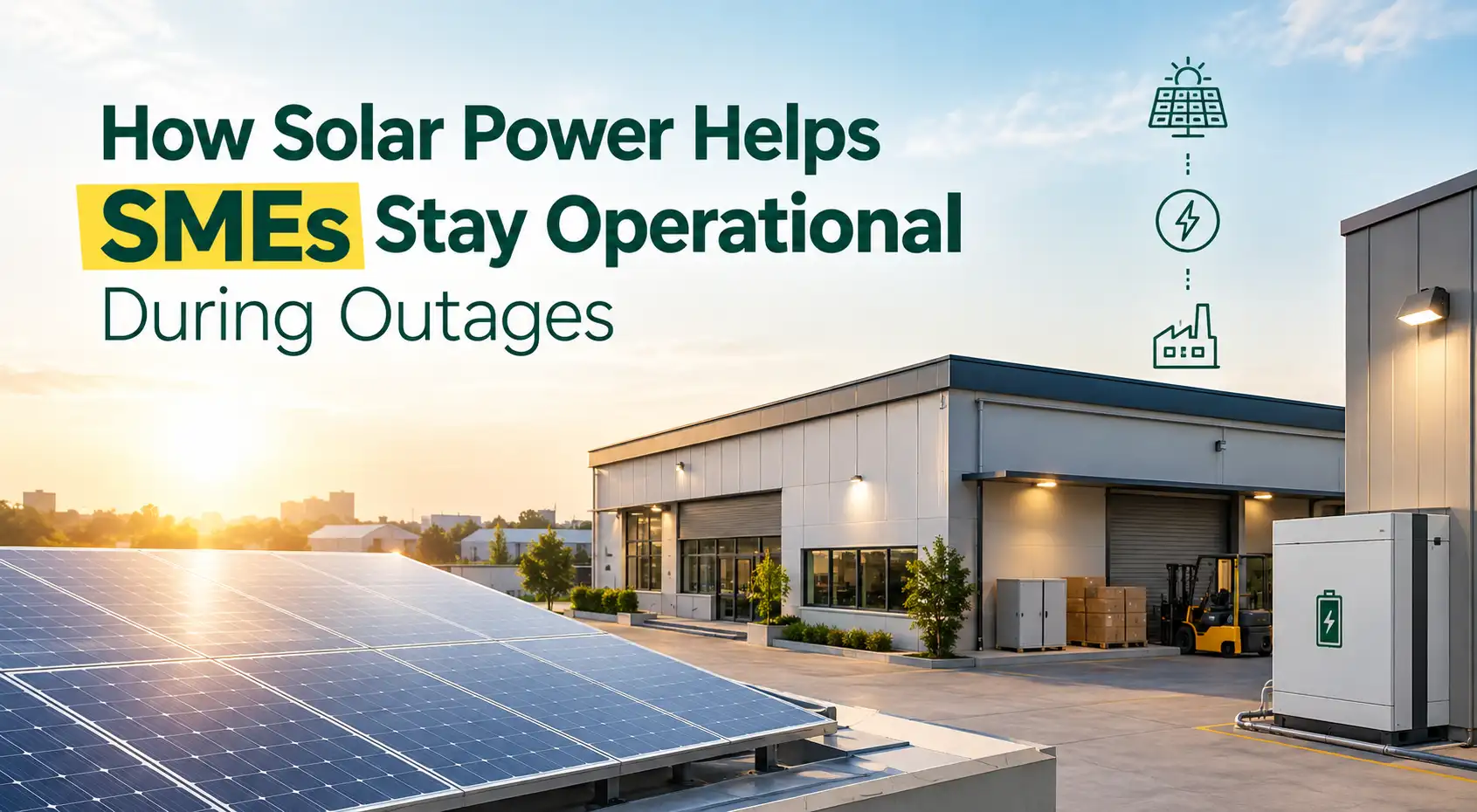
How Solar Power Helps SMEs Stay Operational During Outages
Ask any small business owner in Pakistan what keeps them up at night, and load shedding comes up pretty fast. Electricity for an SME isn’t really a line item. It’s what decides whether the machines run today, whether the order ships on time, whether a customer gets served or told to come back later. Grid drops, and everything else follows it down within minutes.
Most businesses cope the same tired way. Diesel generators, UPS units, sometimes both stacked together. It works, sure. The lights come back on. But run a generator for a season and you start feeling the trade-offs: fuel bills that move with global oil prices whether you like it or not, maintenance that’s somehow always “urgent,” the noise, and never quite knowing what backup power is going to cost you this month versus last. Research on small-scale industry in Punjab has flagged the same thing happening over and over. Outages keep nudging businesses toward these same expensive stopgaps.
Solar gives you a different way in. It’s not a magic fix, and it’s definitely not something you install and forget about. But paired with the right storage and backup setup, it actually changes how tied a business is to the grid to keep functioning.
The Real Cost of an Outage Isn’t Just the Electricity
It’s easy to think of a power cut as a temporary annoyance. Lights go off, they come back, life continues. That’s rarely the whole story once you’re actually running a business.
A small manufacturing floor loses power mid-run and the machines just… stop. Workers stand around. A target that looked doable that morning quietly stops being doable. A retail shop loses its till, its fridges, maybe its Wi-Fi, and whatever sales would’ve happened in that window just don’t happen. An office loses its servers, and everyone’s afternoon gets pushed to tomorrow whether they like it or not.
If you’re dealing with anything perishable, it gets worse fast. A few hours is sometimes all it takes for stock to spoil, and spoiled stock is money you’ve already spent, gone.
One bad afternoon isn’t the end of the world. But outages rarely stop at one. String enough of them together and they quietly eat into output, into how patient customers stay, and eventually into what’s left at the end of the month.
What Solar Actually Changes
Really, the appeal of solar for a small business comes down to control. Instead of buying every unit from the grid, you’re making some of it yourself, on your own roof, during the hours you’re open anyway.
That daytime generation handles a good chunk of what a typical SME needs day to day: lighting, computers, cooling, whatever equipment is running. Buy less from the grid, and the bill gets smaller. It also gets less erratic, which for a lot of owners matters just as much as the size of it.
On tight margins, predictability is worth almost as much as savings. You stop treating electricity like some unavoidable expense that does whatever it wants each month, and start treating it as something you paid for once and now just… own, for years.
Okay, But Does It Work When the Grid Actually Fails?
Funny enough, this is the question most people don’t think to ask until after the panels are already up on the roof. And the answer isn’t a clean yes.
A basic grid-tied system shuts itself off the moment the grid goes down. That’s not a design flaw. It’s a safety requirement, meant to protect the line workers out fixing the fault. But it does mean panels by themselves won’t keep your lights on during load shedding. That surprises people.
Getting actual backup out of solar means adding batteries and the right inverter setup alongside the panels. Solar plus storage banks whatever extra energy gets made during the day and releases it the second the grid drops, shifting selected loads over to battery automatically.
That’s really the line between “solar that shrinks my bill” and “solar that keeps my business open.”
Solar Plus Battery Storage: Where the Real Backup Comes From
A Battery Energy Storage System, or BESS if you want the acronym, is really doing the heavy lifting here.
Panels make more electricity during the day than most businesses actually use in the moment. That surplus doesn’t have to go to waste; it gets stored. Then when the grid drops, the batteries take over quietly, no generator to start, no switch to flip.
And nobody needs the whole building backed up. A decent system lets you pick what actually matters when the power’s gone. For most SMEs that shortlist ends up looking something like this:
- Computers and network equipment
- Security cameras and access control
- Core lighting
- Internet and communication systems
- Refrigeration units
- Select machinery
- Whatever production process can’t afford to stop
Trying to power the entire facility every single time is usually overkill, and expensive overkill. Deciding what actually matters first is just the more sensible way to build the system.
Cutting the Cord on Diesel
Generators have been the go-to backup for Pakistani businesses for decades. Fair enough, they deliver real power when you need it, no argument there. What wears people down is everything around that: fuel runs, servicing that never seems to be scheduled at a convenient time, the noise, and fuel prices that move on their own timeline regardless of yours.
Solar with storage sidesteps a lot of that headache. There’s no fuel truck to wait on since the energy’s made right there and stored for whenever it’s needed. The U.S. Department of Energy has made roughly the same argument in its own resilience planning work, pointing out that pairing solar with storage strengthens reliability because generation and storage both happen locally.
For most SMEs that just means fewer hours on the generator, less diesel bought, and a quieter operation generally. Generators haven’t disappeared entirely. Bigger facilities, or outages that drag on for half a day, still lean on them. They just don’t have to carry everything anymore.
It’s Not Just About the Machines
Power cuts don’t just stop machines. They stop people mid-thought.
Say the power drops halfway through a meeting. The call cuts, laptops go dark, and even once it’s back, there’s another twenty minutes of everyone logging back in and finding where they left off. Do that a few times a week and the lost time actually adds up. It’s more than it looks like on any single day.
Small teams feel this harder than big companies do. There’s less room to absorb a few wasted hours when every single person’s output actually shows up in the day’s total. Keeping the essentials quietly running in the background just makes for fewer interruptions, and a workplace that feels a bit more solid under people’s feet.
Customers Notice Even When They Don’t See the Outage
Customers rarely know the grid went down at all. What they notice is the late order, the card machine that won’t work, the online order stuck somewhere for an hour with no explanation.
If you can keep the essentials running through an outage, you’re not stuck apologizing for something that wasn’t really your fault to begin with. For an SME still working on its name, that kind of steadiness ends up being a selling point nobody put on the price list.
The Bigger Picture: Solar as a Growth Decision, Not Just a Backup Plan
Solar isn’t only useful in the moments the grid fails.
Day to day it just lowers what you’re pulling from the utility, which keeps operating costs saner. Then during an outage, that same system, assuming it’s got storage built in, keeps the important stuff running. One investment, doing double duty.
No two businesses run on electricity the same way, obviously. A bakery’s load profile has nothing to do with a clinic’s, and a workshop needs something else again from what a retail shop needs. There isn’t really a standard package here. It has to be sized around what you actually use, when you’re open, what can’t afford to go dark, how much roof you’ve got, and how much backup actually makes sense for you.
Why Businesses Choose DSG Energy
Solar isn’t cheap, and getting the sizing wrong is the kind of mistake you don’t find out about until the one day you actually needed the backup and it wasn’t enough.
DSG Energy works from what a business actually uses, not some off-the-shelf template. Planning, installation, monitoring, support after the fact: all of it built around the two things that actually matter, what you’re paying now and how reliable you need the power to be.
Bigger isn’t automatically better here. The right system is the one that matches how your business actually runs, not the biggest panel count someone can sell you.
Maybe the priority is a smaller bill. Maybe it’s running the generator less. Maybe it’s just knowing the fridges stay cold and the servers stay up next time the area loses power for six hours. Whatever it is, a system built around your actual numbers hands some of that control back to you.
Energy is only going to matter more to how businesses run, not less. At some point solar stops being about the savings and starts being about not letting the next outage dictate how your day goes.
“A business cannot control when the grid goes down, but it can choose how prepared it is when it does.”
A Few Common Questions
Not by itself, no. A plain grid-tied system is built to shut off the second the grid does. You’d need a hybrid setup with batteries and proper backup wiring to keep anything running through a cut.
Depends what you’re after. If it’s just a smaller bill during normal hours, not really. If you want power during a cut, or you want to use the solar you made during the day after the sun’s gone, then yes, batteries are the piece that makes that possible.
For a lot of the essential stuff, probably. Heavy machinery or outages that run long are a different story, though. Some businesses will still want a generator sitting there as backup, just in case.
Usually lighting, computers, internet gear, security systems, fridges, and whatever machinery you flag as critical. How much of that you can actually run comes down to your battery size, your inverter, and how much solar you’re generating in the first place.
Pretty much always, yes. Systems scale down as easily as they scale up. Most SMEs start with something sized to what they use right now and what can’t afford to go dark, then leave room to grow it later if the business grows too.
