


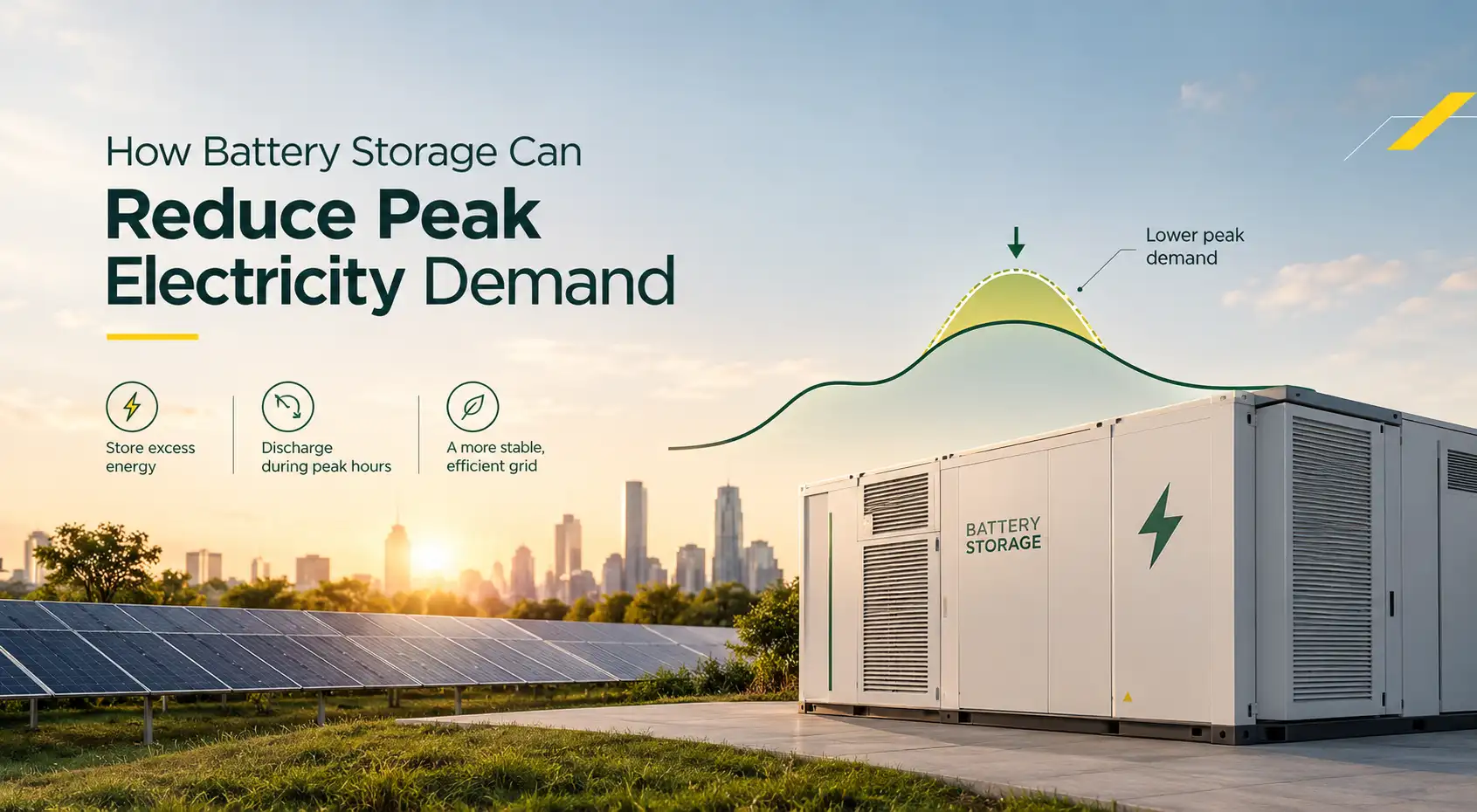
How Battery Storage Can Reduce Peak Electricity Demand
Ask any plant manager which hours of the day worry them most and they’ll usually name the same two or three. Everything is running, the load is at its highest, and the meter is quietly recording a number that will show up on next month’s bill.
That’s peak demand. Battery storage is one of the more practical ways to bring it down, and it’s worth understanding how before you spend money on it.
What Peak Demand Is
Peak demand is the highest amount of power your site draws at any one moment. In a factory that’s usually the time when motors, compressors, pumps, chillers and the lighting load all overlap.
A typical day goes like this. Early on, only a few machines are running and the load is modest. By late morning the whole floor is up and running, and the load roughly doubles. It may stay there for just a couple of hours. But your connection, your equipment ratings and quite often your tariff are all sized around that short window. So you carry the cost of capacity you barely use.
How A Battery Fits In
The battery charges when demand is low, from the grid or from solar. When demand climbs, it discharges and covers part of the load so the grid doesn’t have to. Peak shaving is the name for this.
Take a site that normally draws 2 MW and reaches 3 MW for a few hours. Without storage, the grid delivers the full 3 MW. With a battery, the grid might only need to deliver 2.5 MW while the battery supplies the other half megawatt. The peak is lower, even though the plant ran exactly the same.
How much you can cut varies a lot. Battery capacity and discharge rate matter, and so do your load profile, your shift pattern and how the control system is set up. Two factories of the same size can get quite different results.
The Bill
Plenty of commercial and industrial tariffs have a demand charge. The utility looks at the single highest reading in the billing period and charges you on that. It doesn’t matter if the rest of the month was calm. One bad half hour can set the figure.
That’s why shaving even a small slice off the top can be worth real money. It also makes your load easier to predict, and it’s gentler on transformers and cabling.
The sites that benefit most are the ones with big, uneven swings: textile mills, food processing, cold storage, large warehouses.
If You Already Have Solar
Solar and storage suit each other. Panels produce the most around noon, but a lot of sites hit their demand peak later, around four or five in the afternoon, when output is falling off.
Without a battery, much of the midday generation either gets used when you didn’t need it or is sent back to the grid. With one, you can hold some of it and use it when the load is still high and the sun is low. You get more value out of panels you’ve already paid for.
Industrial Loads
Industrial sites are hard on a power system. A big motor starting, a line ramping up or a chiller switching on can each cause a sudden jump in demand.
A battery that’s sized properly can respond to those jumps fast. If it’s connected to an energy management system that tracks consumption live, you can set a threshold, and the battery discharges when the load approaches it. After the load drops, it recharges. No one has to run around switching things off.
What Else A Battery Can Do
Peak shaving gets most of the attention, but a battery system can also back up key loads, help you use more of your solar, and cushion the effect of an unstable supply.
If a process can’t tolerate a power cut, for example one where a sudden interruption ruins a batch, storage can protect it too.
Still, I’d be cautious. A battery chosen without a proper look at how the site consumes power tends to underperform, and it’s an expensive way to find that out.
Get An Assessment Done First
Before buying anything, find out where your electricity is going and when. A load analysis will show your peak periods, which equipment causes them, how your solar output lines up with demand, and where you’re wasting energy.
With that in hand, sizing becomes a calculation instead of a guess. Bigger isn’t always better. You’d look at capacity, power rating, how often the battery will cycle, expected growth in load, your tariff, your solar size and any backup needs. Skip this step and you could end up with storage that sits mostly idle.
The Control System
A battery by itself doesn’t do much. The software running it is what makes it useful. An energy management system watches your loads, solar output, the battery’s charge level and your grid draw. Using the rules you’ve set, it decides when to charge, when to discharge and how much.
Where a site has several sources, say solar, a battery and a generator, good coordination between them makes a noticeable difference.
Why DSG Energy
At DSG Energy we don’t treat battery storage as something you just bolt on. A textile mill, a retail chain, an office building and a farm each use power in their own way, so one design won’t fit them all. We start by looking at how your business uses electricity.
After that, we can help you work out what you need, find where peak demand is costing you, connect storage to your solar system and build a design around your daily operation.
With solar, storage and decent controls working together, you have a lot more say over how and when you use power. Storing the energy is only half of it. Deciding when to use it is the rest.
Frequently Asked Questions
It means using stored battery energy when demand is high, so you draw less from the grid at that time. If your tariff includes demand charges, it can bring them down.
They can. If you move some of your grid use away from expensive or high-demand periods, you may spend less. How much depends on your tariff, load profile, battery size and how it’s operated.
Usually. The equipment has to be compatible and the integration needs proper engineering. The battery holds extra solar output and releases it when the panels produce less.
It depends on how much energy the battery holds and how big the load is. A larger battery will run the same load for longer. That’s why the design should be based on what your facility really needs.
Yes. Industrial sites use it for peak shaving, getting more from solar, backing up important loads and managing consumption. Whether it’s worth it depends on how the facility uses power.
