


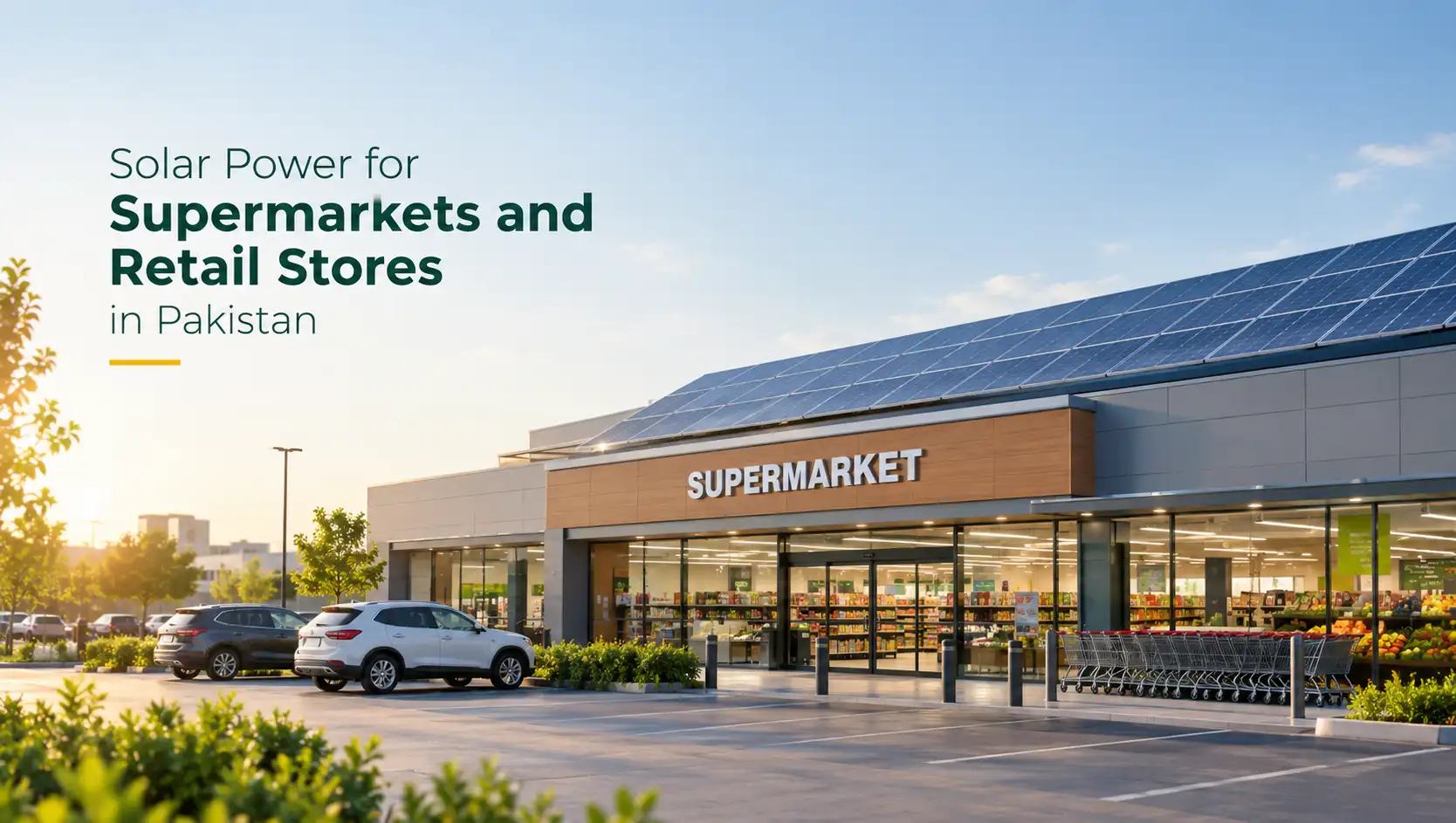
Solar for Supermarkets and Retail Stores in Pakistan
Talk to a supermarket owner about costs and the conversation ends up at the electricity bill sooner or later. Rent doesn’t change. Staff salaries you can plan for. The bill? In June it’s a shock, and in July it’s worse.
Here’s what a decent-sized store is doing at 2 pm in summer. Air conditioners on full. Chillers and deep freezers running since the morning. All the lights on, a handful of billing counters, a server in the back office, cameras. Everything pulling power just when the sun is beating down on the roof. That overlap is why solar suits shops better than most businesses.
Your Peak Hours Are Already Sunny Hours
A factory can push some work into the night shift. A supermarket can’t. People shop when they shop, and that’s mostly daytime and early evening.
So most of your load already falls while panels are producing. This matters because a plant pays back fastest when its power gets used straight away. If you make electricity at noon and need it at midnight, you’re relying on batteries or on the grid rules. If you make it at noon and use it at noon, no problem.
Cutting Usage Isn’t Really An Option
The usual advice is “switch off what you don’t need.” Fine for an office. Not for a store. Dairy and frozen stock need to stay cold, customers walk out of a stuffy shop, and when the POS goes down the queue builds and people leave without buying.
What you can change is where the power comes from. That’s the whole argument for putting panels on the roof.
Where A Store’s Power Actually Goes
AC is normally the biggest load, and in our summers it follows the sun closely. Refrigeration is second and never stops, so solar covers its daytime share. After that comes lighting (inside, plus the car park), then signboards, screens, POS machines, routers and CCTV.
The split changes from store to store. A shop with a big frozen section looks nothing like one that sells mostly dry goods. That’s why sizing a plant from a rule of thumb is a mistake.
The Roof
Lots of supermarkets and plazas have large flat roofs that do nothing but gather dust. Good place to start.
Just don’t assume all of it should be covered. Somebody has to check what the structure can carry, where the water tanks and parapet walls throw shade in the morning and late afternoon, and which way the panels will face. The electrical side needs a look too: distribution boards, cabling, the transformer. And if you’re adding a floor in a couple of years, plan for that now, not after the panels are bolted down.
Right-sized beats biggest.
Evenings and Outages
Many stores trade until 10 or 11 at night. Panels don’t. A battery system (BESS) can store some of the daytime surplus and run selected loads after sunset or when the grid trips.
If you’ve ever lost a cold room to a long outage, you know what that stock is worth. In that situation a battery is closer to insurance than to a gadget. Solar makes the energy; the battery decides when you can use it.
Before You Sign
Get a site visit first. A quotation that shows up before anyone has seen your roof is a guess.
Know your monthly units and your peak demand. Have the existing electrical setup checked, because an old distribution board or an overloaded transformer becomes a problem once solar is connected. Ask exactly which panels, inverters and mounting structure are on the offer. Cheap components are where trouble usually begins, and it often shows up years later.
Ask about net metering and current tariff rules with your distribution company too. They’ve changed more than once, and they affect your payback.
And find out who looks after the plant once it’s running. Dust builds up quickly here. A dirty array quietly loses output and nobody notices until the bill arrives. Cleaning, inspections and monitoring aren’t extras.
More Than A Lower Bill
Yes, the bill comes down. But the cost also becomes easier to predict, and an unused roof starts to earn. If you run several branches, each store can be assessed on its own and one dashboard shows head office how they compare. If your company has sustainability targets, on-site clean power is something you can actually point to.
Working with DSG Energy
DSG Energy designs and builds solar plants and battery storage for commercial and industrial customers, and looks after operation and maintenance afterwards. For a retail client we start with how that particular store uses power, then work out the design from its roof, trading hours and plans.
Get it right and the month-end bill stops being a surprise. That’s really the point.
Questions People Ask
Usually. Heavy daytime use for cooling, lighting and refrigeration is what solar handles best. The right size depends on your load and your roof.
Depends on your tariff, the plant size and how much you use directly. Ask for numbers based on your own bills, not a general promise.
Often yes, but plan for it at the design stage so the inverters and layout allow it.
Depends on capacity, panel type and shading. A site visit answers this properly.
Solar plants, battery storage, engineering, installation, monitoring and O&M, built around your store’s consumption.
