


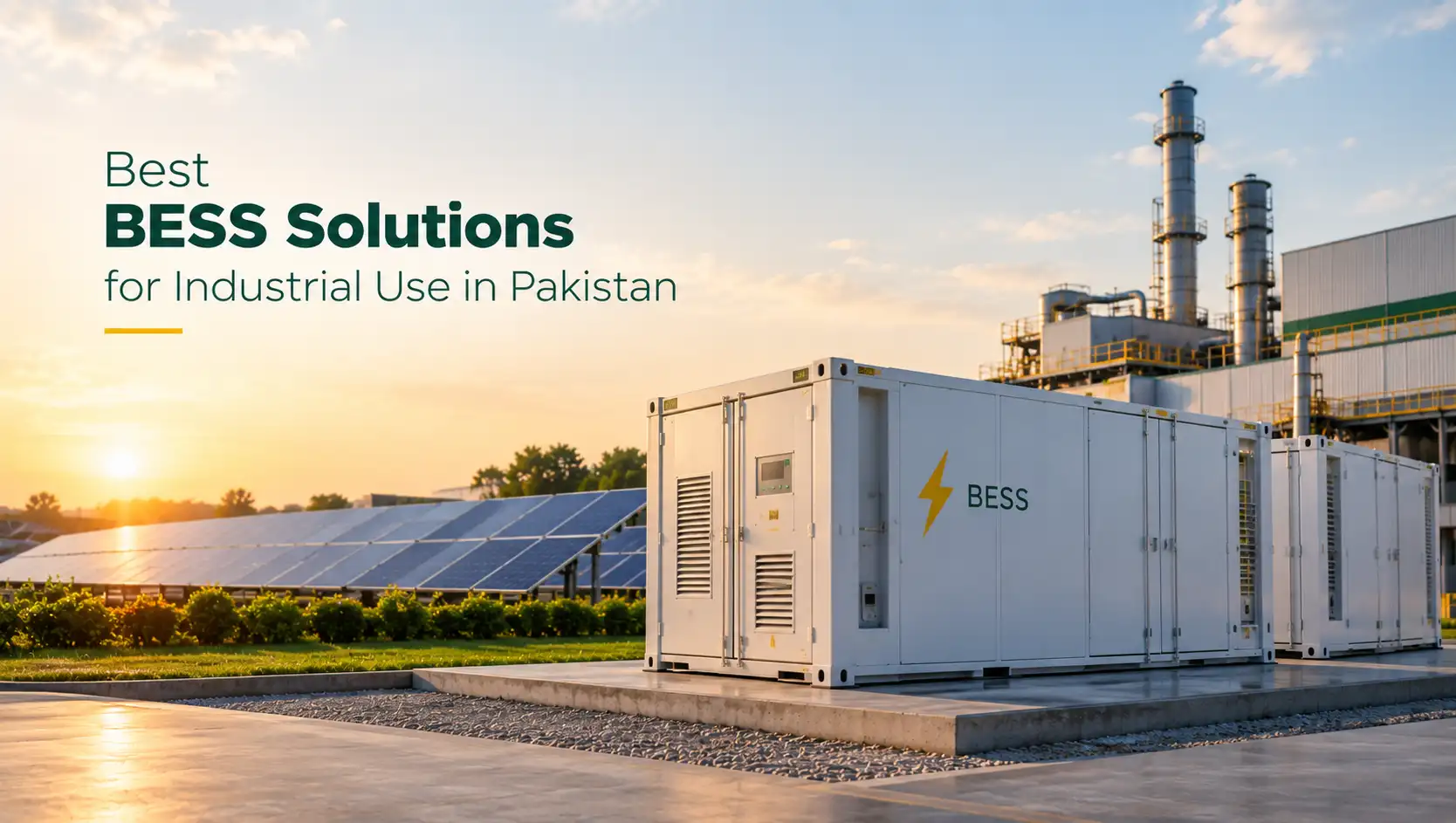
Best BESS Solutions for Industrial Use in Pakistan
If you’re running an industrial setup in Pakistan, you already deal with this every week: power bills climbing, the grid cutting out without warning, and production schedules getting thrown off because of it. Battery Energy Storage Systems, BESS for short, have moved from “nice idea” to something businesses are actually installing, because the problem they solve is a real one, not a hypothetical.
The idea itself isn’t complicated. Store power when you’ve got it to spare, use it when you don’t. Pair that with solar and it gets a lot more useful, because the electricity your panels are throwing off at noon doesn’t just vanish once the sun’s down. It sits in a battery until you need it, whether that’s for the evening shift or the next time the grid decides to fail you.
What’s actually inside a BESS
People tend to picture a BESS as just a wall of batteries, but that’s really only part of it. A real industrial system has inverters, a battery management system, some software running the show, cooling, protection gear, and monitoring, all tied together. If any one of those pieces is missing or poorly integrated, the rest doesn’t work as well as it should.
There’s also no one-size-fits-all version of this. A textile mill running around the clock needs something completely different from a food processing plant that only operates in daylight hours. What matters is how much power gets used, when it gets used, whether there’s already solar on the roof, and what absolutely can’t be allowed to shut down.
Why industries here are actually going for it
Backup is usually the first reason people bring up. When the grid drops, production lines stop, equipment can get damaged, and in some industries, inventory just spoils. With a BESS, the critical stuff keeps running off stored power instead of everything grinding to a halt.
Solar is probably the bigger long-term story though. Plenty of facilities have panels installed now, but they’re still pulling from the grid in the evening because that’s when demand peaks and the sun’s already gone. Without storage, whatever extra was generated at midday just goes unused. A battery is what actually lets a business use the solar power it already paid to generate.
Peak demand charges are worth mentioning too, especially depending on the tariff a facility is on. If the system can discharge during the expensive hours instead of drawing from the grid, that shows up on the bill. It’s not dramatic for every business, but for some it adds up fast.
And honestly, there’s just the flexibility of not being locked into one power source. Once you’ve got solar, grid, and battery all working together, an energy management system can shift between them depending on what’s happening at any given moment, rather than the facility being stuck with whatever the grid gives it.
Not every BESS setup looks the same
Solar-integrated systems are the most common entry point, mostly because so many facilities already have panels or are about to install them. The battery just catches whatever solar generation isn’t being used right away.
C&I systems (commercial and industrial) are built from the ground up for industrial-scale loads, usually handling backup, peak shaving, and solar integration together rather than being built around just one job.
Backup-focused systems take a narrower approach. Instead of trying to keep the whole facility running through an outage, they protect whatever genuinely can’t go down. It’s a more affordable route for a lot of businesses, and honestly a more realistic one.
Then there’s hybrid setups, usually for larger operations, where solar, storage, and grid power all sit under one management system that decides in real time which source to pull from. For bigger facilities this tends to work out better than treating each source as its own separate thing.
Before you buy anything
The mistake a lot of businesses make is going straight to “what’s the biggest battery we can afford” without first figuring out what they actually need. That starts with the consumption data: load profile, peak demand periods, which equipment is non-negotiable, how much solar is already being generated, and how long backup needs to last if the power goes out.
Once that’s sorted, capacity, inverter sizing, cooling, and safety requirements all follow from there. It’s worth thinking a bit ahead too. If the business is planning to grow, it makes sense to choose a system that can scale with it instead of one that’s maxed out within a year or two.
The software matters as much as the hardware
A battery without decent management software is really just dead weight sitting in a room. The energy management system, or EMS, is what makes the whole thing worth having. It tracks generation, consumption, battery status, and grid conditions, and decides when to charge or discharge based on rules set up ahead of time.
So when solar output is strong, it prioritizes charging the battery. When output drops or demand spikes, stored energy goes out automatically, without someone needing to sit there managing it hour by hour.
Where this is headed
Industrial energy in Pakistan is moving away from “just generate more power” toward “manage what you’ve already got, better.” Solar cuts down how much a business depends on the grid. Storage gives control over when that power actually gets used. Put together, it’s becoming a pretty practical way for industries to deal with load shedding and rising tariffs instead of just absorbing the cost year after year.
Why DSG Energy
A lot of providers treat the battery itself as the product. DSG Energy treats it as one part of a bigger energy strategy, starting with a real look at the facility’s energy profile before anything gets designed. Solar integration, storage sizing, and ongoing support all get built around what the business actually needs, not around whatever’s easiest to sell.
With experience across solar, storage, and industrial power projects, DSG Energy works through the details with businesses to land on a setup that actually fits how they operate.
FAQs
Battery Energy Storage System. It stores electricity and releases it when needed. Industrially, that covers backup power, solar storage, peak demand management, and general energy optimization.
Yes, and it’s arguably the best combination there is. Excess solar generation gets stored during the day and used later, usually in the evening when generation has dropped off.
Yes. Systems get scaled based on consumption, load profile, and backup needs, and can be used for energy shifting, peak demand management, or renewable integration depending on what the facility actually needs.
It comes down to consumption, peak load, which equipment is critical, how long backup needs to last, existing solar generation, and operating hours. A proper site and load assessment should happen before anything gets sized.
Yes. Systems are designed around the facility’s actual consumption patterns, existing or planned solar, and operational priorities, not a generic package.
